
How to File a Middlesex County Public Records Request
The Open Public Records Act, or OPRA, gives the public a right to government records held by county and local offices. The law is N.J.S.A. 47:1A-1 et seq. The single most important step is sending the request to the office that actually holds the record, called the custodian. A request to the wrong office is not complete and can be denied.
Before you file, decide which office holds what you want and describe it clearly. The steps below outline the process.
- Identify the correct custodian, such as the County Clerk, Surrogate, courts, jail, or a municipal office.
- Describe the records you want with enough detail to find them.
- Submit through the county Request for Public Records process or the right agency form.
- Choose a delivery and copy method and note any fee.
- Track the response deadline, and appeal if the request is denied.
OPRA vs Court Rule 1:38
New Jersey splits public access into two systems, and mixing them up causes most denials. OPRA covers executive and local government records: county departments, the sheriff, the prosecutor, corrections, and municipal agencies. Court records are different. They follow New Jersey Court Rule 1:38, which is administered by the Judiciary, not by OPRA custodians.
So a request for a deed goes to the County Clerk under OPRA, but a request for a court case file follows the Judiciary's rules. The Government Records Council OPRA FAQ explains the OPRA side and the appeal process.
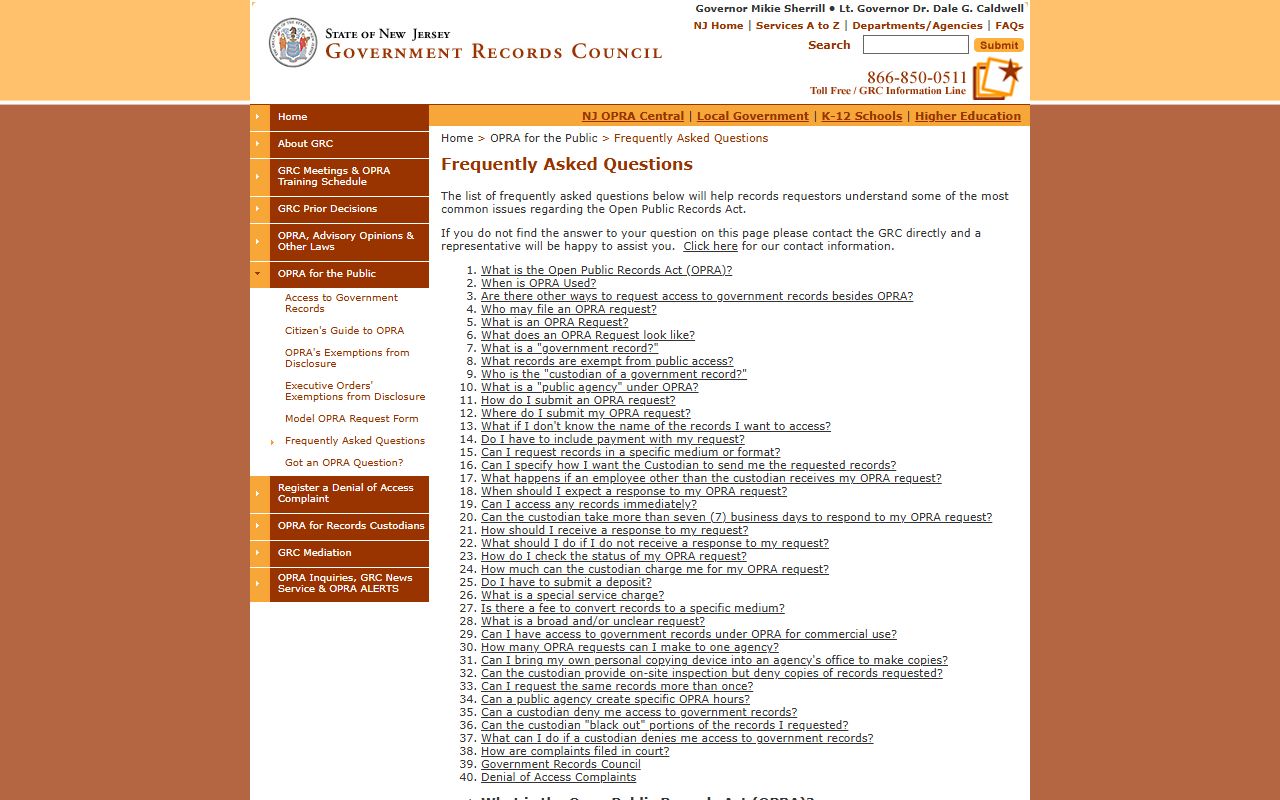
Court records access, by contrast, is governed by Rule 1:38 and the Judiciary's own request channels.
Choosing the Right Custodian
Because records are spread out, knowing the custodian is half the work. Each office holds a defined set of records and answers requests for those records only. The table maps common records to the office that keeps them.
| Record | Custodian | System |
|---|---|---|
| Court case files | NJ Courts / Middlesex Vicinage | Court Rule 1:38 |
| Land, deeds, trade names | Middlesex County Clerk | OPRA |
| Wills and estates | Middlesex County Surrogate | Surrogate process |
| Jail and inmate records | Adult Corrections | OPRA |
| Police and municipal records | Municipal agencies | OPRA |
OPRA Request Form Fields
An OPRA request asks for a few standard pieces of information so the custodian can find and deliver the record. The table lists the fields a request generally includes.
| Field | Type | Required | Notes |
|---|---|---|---|
| Requestor name / contact | Text | Yes | For the response and any fee notice. |
| Custodian / agency | Selector | Yes | The office that holds the record. |
| Record description | Text | Yes | Be specific to avoid denial. |
| Delivery / copy method | Selector | Yes | Pickup, mail, or electronic copy. |
The state OPRA request guidance stresses that a request must reach the custodian in charge of the record to be valid.
Fees and Response Timelines
OPRA sets the basic rules for fees and response times. Under N.J.S.A. 47:1A-5, custodians must give prompt access and charge fees tied to actual copy costs unless a special service charge is legally justified. Specific copy rates vary by office, so confirm the current amount. The table shows a few posted county examples for reference.
| Item | Fee |
|---|---|
| Standard copies (OPRA) | Tied to actual copy cost |
| Surrogate copies per page | $3 |
| Surrogate estate search | $10 |
| Special service charge | Only if legally justified |
Note: OPRA requires prompt access and sets response deadlines, but court records follow the Judiciary's own timelines rather than OPRA's.
What the County Clerk Holds
A big share of county public records sits with the Middlesex County Clerk. This office is separate from the courts and the Surrogate. It records documents that affect real estate, files trade names, processes passports, certifies notaries, and plays a central role in elections. It also runs an online record search for land documents.
The land system reaches back decades, with deeds from 1929, mortgages from 1950, and other documents from 1958 to present. For these records, the County Clerk page has the details. For court case files, the court records page is the right starting point.
The County Clerk also handles a set of records people do not always link to that office. Passport applications, notary certifications, trade name filings, and veteran ID cards all run through the Clerk. Election records and candidate filings pass through there too. Because so many functions sit under one roof, it is worth confirming the Clerk is the right custodian before assuming a record lives with the courts or another county department.
Records Restricted from Public Access
Open access has limits. OPRA's definition of a government record, at N.J.S.A. 47:1A-1.1, lists categories that are excluded. On the court side, Rule 1:38 protects sealed records, personal identifiers, juvenile and family-sensitive material, and certain domestic violence information. Expunged criminal records are isolated under N.J.S.A. 2C:52.
So a request can be lawfully denied if the record is exempt. When that happens, the custodian should say which exemption applies. For sensitive court matters, access often requires being an authorized party or getting a court order. Knowing this in advance saves frustration, since pushing for a clearly exempt record will not succeed no matter how the request is worded or how many times it is filed.
Appeals and Denials
A denial is not the end of the road. Under N.J.S.A. 47:1A-6, a requestor can challenge a denial in the Superior Court or through the Government Records Council. The Council offers an administrative path that is generally cheaper and simpler than court. Either route reviews whether the record should have been released.
Federal records follow a separate system entirely. The U.S. Attorney's Office for the District of New Jersey handles federal matters in the area.
For national jail and justice statistics, federal sources like the Bureau of Justice Statistics publish data the county does not.
The jail population page explains how to request aggregate county jail data under OPRA.
Common Public Records People Request
Public-records requests in Middlesex County cover a wide range of needs. Some are personal, like getting a copy of a deed or a court order. Others are professional, like a title search or a journalist's records request. The county and its offices handle a steady flow of these. The most common requests fall into a few buckets.
- Court case files and dockets through the Judiciary.
- Deeds, mortgages, and trade names through the County Clerk.
- Wills and estate documents through the Surrogate.
- Jail booking and inmate records through Adult Corrections.
- Police reports and municipal court records through local agencies.
Each of these lives with a different custodian, which is why the routing step matters so much. Sending all five to one office would only slow things down.
Tips for a Successful Request
A well-built request gets a faster, cleaner answer. The biggest mistake is being too vague, which gives the custodian a reason to ask for clarification or deny the request. Naming dates, parties, document types, or a case number narrows the search and speeds the response. It also lowers the odds of a large copy fee for records you do not actually need.
Pick a reasonable scope. A request for every email an office ever sent will stall, while a request for a specific deed or a single case file moves quickly. If you are not sure an office holds the record, a quick call before filing can save days. And keep a copy of what you submitted, since that record helps if you need to appeal a denial to the Government Records Council or the Superior Court. Patience helps too, because some records take time to locate and review for exempt material before they can be released.