
How to Search Middlesex County Court Records
Court records in Middlesex County are mostly state Judiciary records, not county clerk files. Civil, foreclosure, judgment lien, and tax cases are searched through the New Jersey Courts "Find a Case" tools. Municipal traffic tickets run through a separate state portal. The Middlesex County Clerk holds land records, not court cases, and the Surrogate holds estate records. Sorting the case type first is the real first step.
Before you start, gather what you have. A party name, a docket number, or a case year all help. Name searches work best when you try spelling variations. Keep the county set to Middlesex so the results stay local.
- Decide the case type. Civil, criminal, family, probate, traffic, and tax each route to a different system.
- For civil and foreclosure matters, open the NJ Courts Civil and Foreclosure Public Access page and launch the search portal.
- Enter a party name or docket number, then set the county to Middlesex.
- Review the docket entries, parties, filing date, and status shown in the result.
- For a certified copy or an older file, call the right division at 732-645-4300 or visit the courthouse records room.
Searching the Superior Court Case Portal
The NJ public access case search portal drives most online court lookups. It is a free, JavaScript-based tool. Some full case images still require a court request or account, so the portal is a starting point, not the whole file. The fields below come from inspecting the civil and foreclosure search interface.
| Field Label | Type | Required | Notes / Format |
|---|---|---|---|
| Docket number | Text | No | Use if the full docket number is known; prefixes signal case type. |
| Party name | Text | No | Try surname and business name variations. |
| County | Dropdown | Sometimes | Select Middlesex for local cases. |
| Case type / party type | Dropdown | No | Options appear in the live portal interface. |
| Search | Button | Yes | Runs the query. |
A live result returns the docket number, case caption, case type, venue, filing date, status, party names and roles, attorney names, and docket events. Redactions follow Court Rule 1:38.
The Middlesex County Judicial System
New Jersey runs a single statewide court system. The court most people mean when they ask for Middlesex County court records is the Superior Court, which operates locally through the Middlesex Vicinage, also called Vicinage 8. It is not a county-created court. Above it sit the Appellate Division and the Supreme Court of New Jersey. Below it, municipal courts handle traffic, local ordinances, and minor offenses.
Civil matters split by dollar amount and remedy. The assignment judge listed by the Judiciary is Michael A. Toto, and the trial court administrator is Greg Lambard. The table sums up where each kind of case is heard.
Case flow: Municipal Court › Superior Court (Law or Chancery Division) › Appellate Division › Supreme Court of New Jersey
| Court | Level | Middlesex Function |
|---|---|---|
| Supreme Court of New Jersey | Highest appellate | Final state appeals; administers the Judiciary. |
| Superior Court, Appellate Division | Intermediate appellate | Reviews trial and Tax Court decisions. |
| Superior Court | Statewide trial | Civil, criminal, family, general equity, probation. |
| Tax Court | Specialized | State tax and property-tax appeals. |
| Municipal Courts | Local limited | Traffic, ordinances, disorderly persons offenses. |
| County Surrogate | Probate | Probates wills and administers estates. |
More detail on each trial division sits on the Middlesex County Superior Court page.
Middlesex County Courthouses
The vicinage runs from two main buildings in downtown New Brunswick. The main courthouse handles Law Division civil and criminal work. The Family Courthouse a few blocks away handles divorce, custody, child support, domestic violence, and juvenile matters. The Surrogate and County Clerk sit in the County Administration Building nearby.
The New Jersey Judiciary lists the courthouse details on its Middlesex vicinage page, which shows addresses, the assignment judge, and contact lines. That page is a good check before any visit.
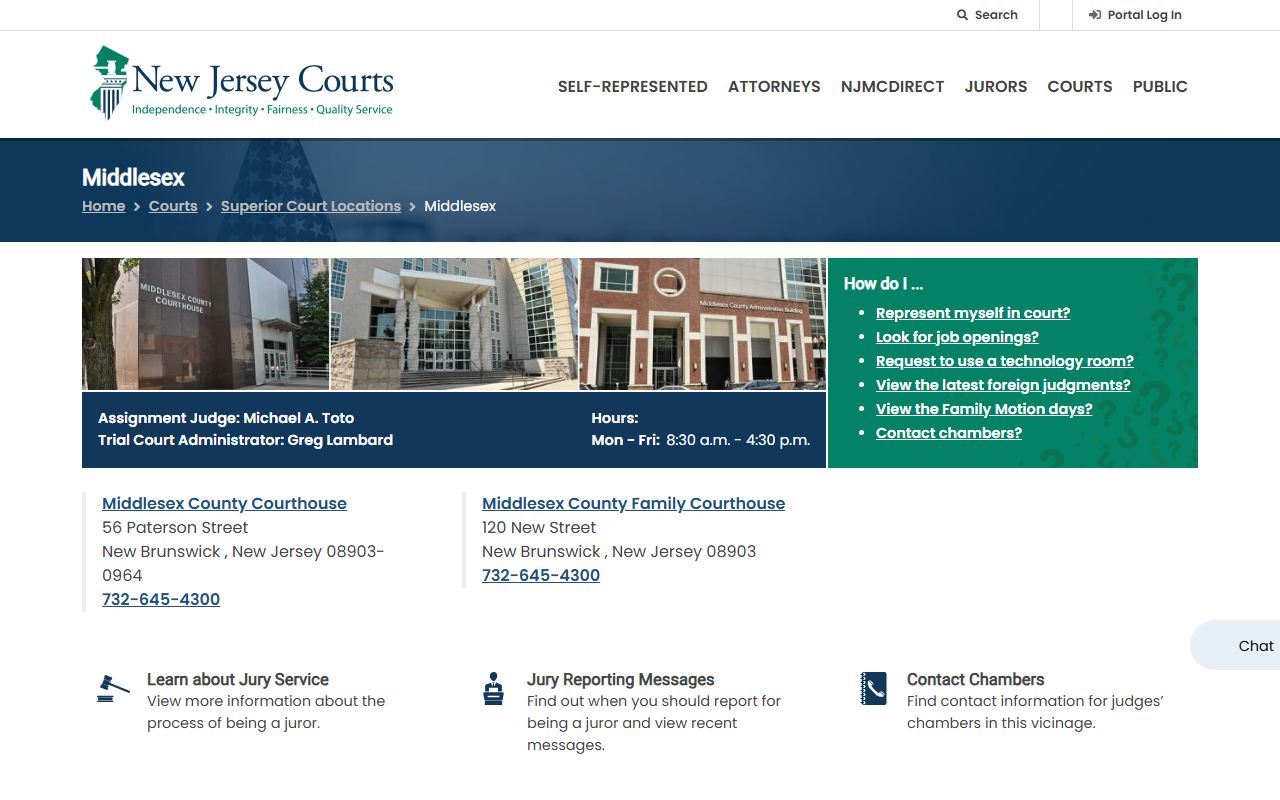
Public court hours run Monday through Friday, 8:30 a.m. to 4:30 p.m. Confirm which building is on your notice before you park, because the two courthouses are not the same address.
Middlesex County Courthouse
56 Paterson Street
New Brunswick, NJ 08903-0964
732-645-4300
Middlesex County Surrogate
75 Bayard Street, 1st Floor
New Brunswick, NJ 08901
732-745-3055
Types of Court Records Available in Middlesex County
The Superior Court and the municipal courts produce most case records. Each division keeps its own files. Some are open to anyone; some are limited by court rule. What is public depends on the case type and on Rule 1:38.
Here are the main record types people pull in Middlesex County.
- Civil records - complaints, answers, motions, orders, and judgments, including Special Civil Part and small claims.
- Criminal records - complaints, indictments, plea forms, judgments of conviction, and sentencing orders.
- Family records - divorce, custody, and child support files, with adoption and juvenile matters heavily restricted.
- Probate records - wills, estate administration, and guardianships held by the Surrogate.
- Traffic and municipal records - tickets, fines, points, and disposition entries.
What Middlesex County Court Records Show
A court record is built from standard fields. The same basic layout appears whether the case is civil, criminal, or family, though the content differs. Knowing the fields helps you read a docket without guessing. The list below tracks what a typical Middlesex County case file holds.
| Field | What It Shows |
|---|---|
| Docket Number | The case ID, usually with a prefix for type, a sequence, and a year. |
| Venue | Middlesex County and the Middlesex Vicinage. |
| Parties | Plaintiff and defendant, or State and defendant, or petitioner and respondent. |
| Filing Date / Status | When the case was filed and whether it is active, disposed, or closed. |
| Docket Entries | Each filing, motion, order, hearing, and judgment in date order. |
| Disposition | The outcome, such as judgment, dismissal, or sentence. |
Public Access Laws for Middlesex County Court Records
New Jersey uses two overlapping access systems. The Open Public Records Act, or OPRA, covers county, municipal, prosecutor, sheriff, and jail records. Court records follow New Jersey Court Rule 1:38 instead of ordinary OPRA practice. The key is asking the right custodian: the courts for case records, the County Clerk for land records, the Surrogate for estates, and Adult Corrections for jail records.
Key Statutes:
N.J.S.A. 47:1A-1 et seq. (OPRA) - Sets the policy of open access to government records and lists the exemptions.
Court Rule 1:38 - Governs public access to court records and names the records that stay private.
N.J.S.A. 2C:52-1 et seq. - The expungement law, which isolates eligible criminal records from public view.
If a request is denied, OPRA lets a person challenge it through the Government Records Council or the Superior Court. More detail sits on the Middlesex County public records page.
Records That Are Restricted or Confidential
Not every court record is open. Rule 1:38 starts from public access but pulls back many categories. Juvenile charges are confidential by law. Adoption files, domestic violence details, and grand jury materials are closed. Expunged records are sealed under N.J.S.A. 2C:52. Personal identifiers like Social Security numbers and minor names are redacted on filings.
To view a sealed record, a person usually needs a court order or must be an authorized party. For expungement, the petition goes to the Superior Court, and a granted order is sent to the courts, police, prosecutor, corrections, and the State Police Expungement Unit. Mental health and civil commitment records carry their own privacy limits.
Specialty Courts in Middlesex County
The vicinage runs problem-solving programs alongside the regular criminal calendar. Recovery Court, also known as Drug Court, is a Criminal Division resource reached at 732-645-4300 ext. 88062. It serves people whose crimes tie to addiction, with treatment and close supervision instead of a standard sentence. The Prosecutor's Office assigns an assistant prosecutor to work with the court, defense, probation, and treatment providers.
Pretrial Intervention, or PTI, is a diversion track in the Criminal Division. It is not a separate court, but it changes the record. Docket entries may show a PTI application, admission, postponements, and dismissal after completion. Both programs leave a trail on a criminal record, which matters when reading a case.
Middlesex County Sheriff and Jail
The county keeps the Sheriff's Office and Adult Corrections separate. Sheriff Mildred S. Scott leads the Sheriff's Office; the county notes she was the first female sheriff in Middlesex County and the first African American sheriff in New Jersey. The Middlesex County Adult Correction Center is on Apple Orchard Lane in North Brunswick, reachable at 732-297-3636.
The jail publishes an online inmate lookup for people currently housed there. For booking and release searches, see the Middlesex County inmate records page. For active warrant fields, see the warrant records page.
Marriage, Divorce, and Surrogate Records
Family and estate records sit outside the main case portal. New Jersey marriage licenses come from the municipal registrar where a party lives, not the County Clerk. Divorce decrees from 2016 to present come from Middlesex County Family Court; older ones come from the state Records Center. Probate runs through the Surrogate. See the marriage and divorce records and Surrogate's Court pages for the full steps. A few probate terms help.
- Testator
- The person who made the will.
- Executor
- The person named to carry out the will.
- Intestate
- Dying without a valid will, so the estate follows state law.
- Guardian
- A person appointed to act for a minor or an incapacitated adult.
Middlesex County Records Fees
Copy fees depend on the office. The Surrogate's Records Department publishes a clear schedule for estate records, which gives a good sense of typical county copy costs. Court divisions and the County Clerk set their own fees by document type. The table lists the Surrogate's posted amounts.
| Item | Amount |
|---|---|
| Estate search request | $10 |
| Copies per page | $3 |
| Updated certificate | $5 each |
| Exemplified copy (administration) | $75 |
| Exemplified copy (wills) | $84 for first two pages, $5 per added page |
Pay by check, money order, Visa, Mastercard, or Discover. The Surrogate does not take cash or American Express.
How to Interpret Middlesex County Court Records
Reading a docket takes a little vocabulary. An arrest or a charge is not a conviction. A case can be dismissed, downgraded, or sent to a diversion program. "Dismissed with prejudice" means it cannot be refiled; "without prejudice" means it can. A disposition is the current or final outcome, while a judgment is the court's enforceable decision.
Docket entries read in date order, so the newest action sits at the bottom or top depending on the view. Bench warrants often appear after a missed appearance. If a record looks wrong, the originating division is the place to fix it, not the public portal.
Accuracy and Record Limitations
Online records can lag behind the courthouse. A portal may not show a same-day filing, and an index can update on a delay. Sealed or expunged matters drop out of public view. For anything used for a legal purpose, a certified copy from the court or office is the reliable source.
Note: Always confirm a name, date, or disposition with the originating Middlesex County office before relying on an online court record.
Federal Court Records for Middlesex County
Federal cases do not appear in county or state portals. Middlesex County sits in the U.S. District Court for the District of New Jersey, with appeals to the Third Circuit. Federal civil and criminal dockets are searched through PACER and the District of New Jersey CM/ECF system. Federal inmates are found through the Bureau of Prisons locator. The Superior Court page explains how state and federal courts differ.
History of Middlesex County Courts
Middlesex is one of New Jersey's older counties, with New Brunswick as the longtime county seat. The modern court is part of the unified state system, where the Superior Court works through vicinages rather than separate county courts. Middlesex is Vicinage 8.
One address change is worth knowing for older files. A 2007 Judiciary notice gave the main courthouse a new entrance and street address at 56 Paterson Street, replacing the former 1 John F. Kennedy Square. The Family Courthouse stayed at 120 New Street. Older pleadings and directions may still use the prior address. County demographic context appears on the Census QuickFacts table.
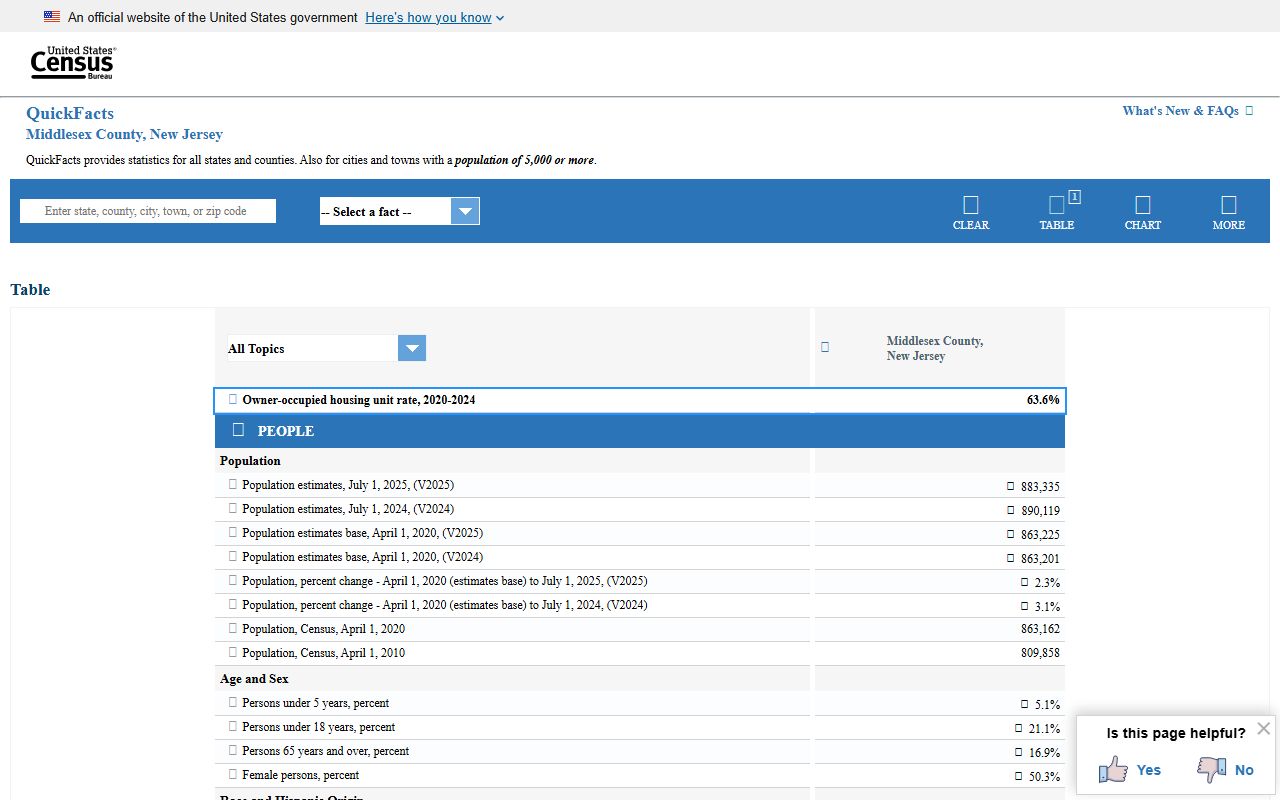
The Census lists 863,162 people in 2020 and an estimate near 883,335 for 2025, spread across 25 municipalities. That scale is why municipal courts carry so much of the county's traffic and minor case load.
Self-Help and Legal Aid Resources
Help is available for people without a lawyer. The NJ Courts self-help center has forms and guides for divorce, expungement, small claims, and landlord-tenant matters. Legal Services of New Jersey and Central Jersey Legal Services offer free help for low-income residents. The Middlesex Ombudsman, at 732-645-4300 ext. 88748, helps court users navigate steps but cannot give legal advice.
Frequently Asked Questions
Is the County Clerk the same as the Clerk of Court?
No. In Middlesex County, the County Clerk handles land records, trade names, passports, notaries, and elections. Superior Court case records are handled by the courts and the Clerk of Court side of the vicinage. Probate runs through the Surrogate.
Where do I get a divorce decree?
Decrees from 2016 to present come from Middlesex County Family Court at 732-645-4300. Certified copies before 2016 come from the Superior Court of New Jersey Records Center at 609-421-6100.
How do I look up an inmate in the county jail?
Use the county inmate lookup or the Archonix XJail public portal, which has Booking Search, Booked Today, and Released Today tabs. The inmate records page walks through the fields.
More answers sit on the Middlesex County Court records FAQ page.